Dancing Christmas Trees
A Designer’s First Impression: Joyful, Compact, and Instantly Recognizable
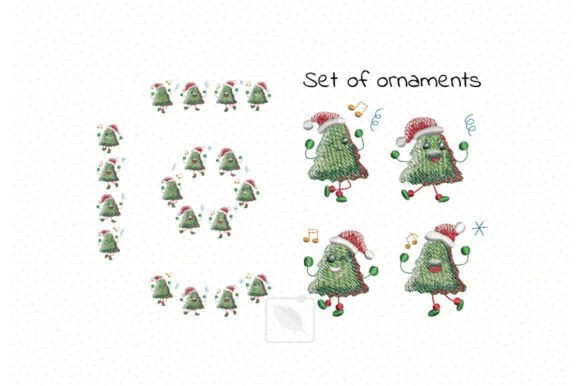
When Dancing Christmas Trees popped up on my screen—a quartet of cartoon pine trees in jaunty red Santa hats, arms (or branches?) raised mid-twirl—I felt that familiar designer spark: not just “cute,” but *usable*. It’s cheerful without tipping into cloying, stylized without losing warmth, and compact enough to land cleanly on a baby onesie or a coffee sleeve. The composition balances motion and stability—each tree leans slightly into the group, creating gentle rhythm rather than static symmetry. That matters. In real embroidery, movement reads as energy; stillness can read as flatness. This design breathes.
Where It Shines: Real Projects, Real Customers
Last week, I prepped a holiday-themed embroidered tote bag for a local boutique—cotton canvas, medium weight, 6” x 8” hoop. I placed Dancing Christmas Trees centered on the front panel, scaled to ~4.2”. Stitched out on mid-weight cutaway stabilizer with 40-weight polyester thread, it held crisp lines across all four figures. No floaters, no thread nests, no distortion in the hat brims or smiling faces. Customers responded immediately—not just “aww,” but “I need that on my kid’s backpack.” That’s the sign of strong visual storytelling in stitch form.
It works equally well on sweatshirt embroidery (the rounded shapes soften nicely against fleece texture), embroidered patches (clean outer edges mean easy trimming), and tea towels (fill stitches stayed dense and legible after two test washes). For Etsy sellers, this is low-risk, high-appeal inventory: pair it with neutral linen pillow covers or organic cotton aprons, and it reads artisanal—not mass-produced. As a machine embroidery design, its strength lies in clarity at scale: enlarge it for a quilt block? Yes. Shrink it for a cap front? Only if your hoop allows clean clearance around the outermost limbs—more on that below.
Where to Pause—and Why
Dancing Christmas Trees isn’t magic on every surface. On thin or stretchy fabric—like jersey baby onesies or lightweight rayon scarves—I’d add tear-away + light cutaway stabilizer and reduce top tension slightly. The dancing poses create subtle negative space between trees; too much give in the base fabric can blur those intentional gaps. On dark fabric, double-check thread color contrast: the Santa hats rely on red pop, and smiles are outlined in satin stitch—low-contrast thread there fades fast.
Caps and curved surfaces demand extra attention. The design’s width spans comfortably across a standard cap front, but the upward-reaching arms sit close to the edge of the typical 4” x 4” hoop. If you’re stitching on a pre-made cap, confirm your machine’s cap frame clearance first. Also, avoid placing it near seams or darts—those tiny facial details and hat folds won’t resolve cleanly where fabric layers shift.
Stitch Density & Detail Integrity
This isn’t a low-density fill-stitch snowflake—it’s got personality in the details: stitched eyes, defined hat bands, and layered branch tips. That means moderate stitch density. On tightly woven fabrics like twill or denim, it anchors beautifully. On loosely woven tea towels or textured burlap? Test first. Over-stabilizing can mute the playfulness; under-stabilizing risks skipped stitches in the tighter curves of the hats. Running stitch accents (like the implied motion lines behind each tree) stay readable down to ~3”, but anything smaller risks merging into fill.
Design Judgment Beyond the Hoop
As a commercial embroidery asset, Dancing Christmas Trees earns trust because it feels handmade—not algorithm-generated. Buyers sense intention in the tilt of a trunk, the asymmetry of a smile. That translates directly to perceived value: a personalized gift with this stitched on a wool-blend blanket feels special, not generic. For small shop owners, it supports brand consistency when paired with complementary designs (think simple holly sprigs or minimalist stars)—not as filler, but as a signature motif.
It also performs well in digital contexts. In printable mockups for Etsy listings, it renders cleanly at 150 dpi—even in grayscale, the shape and gesture remain legible. That’s critical for buyers scanning thumbnails on mobile. And unlike overly intricate holiday motifs, it doesn’t compete with text or logos when used alongside branding.
Practical Notes Every Embroiderer Should Run Through
- Always test on scrap fabric—especially if using textured, dark, or stretchy materials.
- Review stitch density before scaling. Shrinking too far compresses satin-stitched features; enlarging too much may expose fill stitch graininess.
- Confirm hoop size compatibility. The natural spread of the dancers fits best in 5” x 7” or larger hoops—but verify your file’s actual dimensions.
- Inspect small details at 100% zoom in your embroidery software: are the eyes fully digitized? Do hat brims have clean satin edges?
- Test black-and-white mockups to gauge contrast on light vs. dark backgrounds.
- Use appropriate stabilizer: cutaway for knits, tear-away for stable wovens, and fusible for lightweight linens.
- Check licensing before selling finished products or bundling the digital embroidery file—commercial use rights aren’t implied by purchase alone.
Final Thought: A Design That Sells Itself—When Used With Intention
Dancing Christmas Trees isn’t just another holiday embroidery file. It’s a mood, a moment, and a reliable workhorse for craft business owners who know their customers don’t just buy stitches—they buy feeling. Whether stitched onto a handmade baby blanket, an embroidered patch for a craft fair stall, or a custom sweatshirt for a local choir’s holiday gig, it delivers cheer without clutter, charm without compromise. Use it thoughtfully—scale it right, stabilize it honestly, and let those dancing trees do what they do best: make people smile before the first stitch even lands.