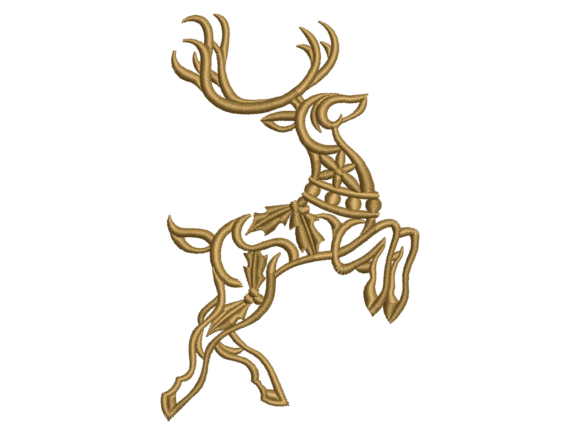
Decorative Running Deer Embroidery
First Impression: Festive, Fluid, and Booth-Ready
As an embroidery designer who’s prepped over 200 craft fair booths—and watched which designs stop foot traffic dead in its tracks—I opened Decorative Running Deer Embroidery expecting charm. What I got was something sharper: a confident, rhythmic silhouette that balances Christmas spirit with modern movement. It doesn’t shout “holiday”—it glides in with quiet elegance. Think rustic-meets-luxury: clean lines, intentional negative space, and a sense of motion that reads instantly at 6 feet. No cluttered antlers or cartoonish eyes—just a graceful, stylized deer mid-stride. That makes it versatile across seasons (yes, even post-Christmas), but undeniably resonant for holiday markets, gift fairs, and boutique pop-ups.
Where It Shines on Craft Fair Products
This isn’t a one-trick design—it’s a booth workhorse. On tote bag designs, the running deer anchors the side panel beautifully: large enough to command attention, lean enough not to overwhelm canvas or linen. As apron embroidery, it lands perfectly above the pocket—eye-catching but not fussy. For tea towel embroidery, it holds up even on textured waffle weave, especially when placed near the hem or corner where movement reads as intentional design rhythm.
As an embroidered patch, Decorative Running Deer Embroidery excels—its outline is crisp, inner details are minimal but legible, and it scales cleanly down to 3 inches without losing identity. On caps, test placement carefully: the curve flattens the stride illusion slightly, so center-front or left-side positioning preserves flow. For small pouches and pillow covers, it serves as a refined focal point—not too busy, not too sparse. And yes, it photographs exceptionally well for printable mockups and Etsy listings: clean edges, strong contrast potential, and natural visual weight.
Production Realities: Speed, Clarity, and Consistency
From a batch-production standpoint, Decorative Running Deer Embroidery is refreshingly straightforward. It’s easy to understand at a glance—no hidden layers, no ambiguous stitch directions. It works powerfully both as a small accent (2.5–3.5”) and a large focal design (4.5–6”), giving you flexibility across your product range without redesigning layouts.
That said—always test. Stitch density is moderate, but check for tight curves around the deer’s legs and neck. On thick fabric like duck canvas or heavy denim, use cutaway stabilizer. On textured towels, opt for medium-weight tear-away plus light topping to prevent skipped stitches in fine contour areas. Dark fabric? Confirm thread contrast—this design relies on shape, not shading, so high-contrast thread (e.g., cream on navy, white on charcoal) maximizes clarity. Avoid ultra-fine lettering or dense fill areas—this design has none, which is a win for reliability.
Booth & Brand Impact: Why Customers Reach Out
In a sea of snowflakes and candy canes, Decorative Running Deer Embroidery stands out by feeling intentional—not seasonal filler. It signals handmade quality without looking “crafty” in a dated way. Customers notice it because it moves. Literally. That subtle kinetic energy triggers curiosity: *“Is it leaping? Galloping? Just passing through?”* That pause—however brief—is your opening to connect.
It elevates perceived value: a simple tea towel becomes a curated kitchen heirloom; a plain tote becomes a statement piece. For small shop products and handmade products, it reinforces brand consistency—especially if you pair it with neutral palettes (oatmeal, slate, moss, cream). In your booth display, group items featuring Decorative Running Deer Embroidery together: a pillow cover beside a matching pouch, an apron draped over a tote. Repetition builds recognition—without repetition feeling redundant.
Designer Notes You Can’t Skip
- Test on scrap fabric first—especially your go-to market fabrics (canvas, linen blend, terry cloth).
- Check thread contrast before stitching 50 units. A mismatched thread can mute the deer’s grace entirely.
- Review spacing and alignment—this design gains strength from balanced margins. Don’t crowd it.
- Confirm hoop size compatibility with your machine. Most versions fit standard 4x4 or 5x7 hoops—but verify before cutting production fabric.
- Inspect stitch density in curved zones. If your machine hesitates, reduce speed or adjust tension.
- Use the right stabilizer: cutaway for stretchy or unstable fabrics; tear-away + topping for textured surfaces.
- Create at least one real mockup—not just digital. See how light hits the stitches in person.
- Compare fabric colors side-by-side: a warm oatmeal vs. cool heather gray changes the mood entirely.
- Confirm commercial licensing before selling finished products—this is a digital embroidery file, and terms vary by seller. Since this listing states “no returns or refunds for digital products,” assume license terms are embedded in purchase—review them carefully.
Final Thought: A Design That Sells Itself—If You Let It Breathe
Decorative Running Deer Embroidery isn’t loud. It doesn’t need glitter or bells. Its strength is in restraint, rhythm, and resonance. It’s the kind of machine embroidery design that turns casual browsers into repeat buyers—because it feels personal, intentional, and quietly special. For Etsy sellers, craft fair product creators, and commercial embroidery makers alike, it’s a smart, scalable asset. Pair it with thoughtful presentation, consistent thread choices, and real-world testing—and watch it become a signature piece in your lineup. Not just another holiday motif. A story in motion, stitched by hand.